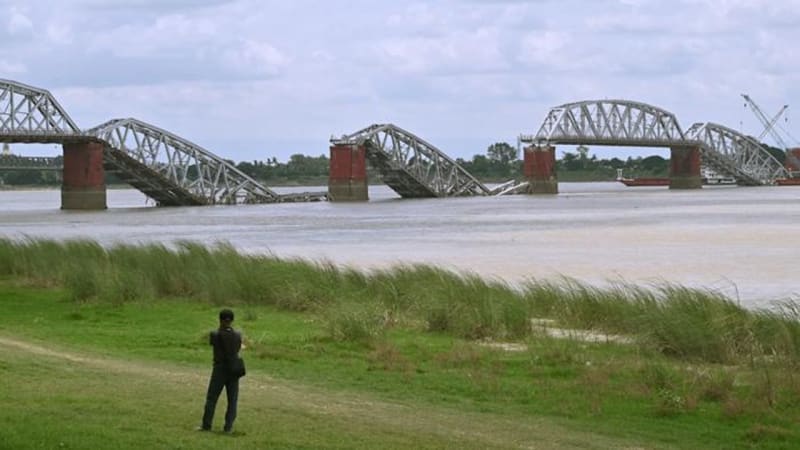
Myanmar Earthquake Reveals Surprising Scientific Insights About Earth's Powerful Fault Lines
A groundbreaking study of the massive Myanmar earthquake offers crucial lessons about how ancient fault lines transfer energy. Researchers uncovered remarkable details about underground geological processes that could transform infrastructure safety worldwide.
When the ground trembles and shifts, few events are as dramatic and devastating as a major earthquake. On March 28, Myanmar experienced a monumental seismic event that not only caused immense tragedy but also provided scientists with unprecedented insights into how Earth's ancient fault lines behave.
The magnitude 7.7 earthquake, which tragically claimed over 5,400 lives, ruptured approximately 300 miles of ground—a remarkable distance that far exceeds typical earthquake rupture lengths. Geoscientists like Eric Lindsey from the University of New Mexico have been studying this event to understand its unique characteristics.
What makes this earthquake extraordinary is its remarkable energy transfer efficiency. Unlike many seismic events where underground movement doesn't fully translate to surface disruption, this earthquake demonstrated a perfect translation of deep geological forces. The Sagaing fault, which dates back 14 to 28 million years, has been smoothed over millennia, allowing an incredibly uniform energy transfer.
Using advanced satellite imagery from the European Space Agency's Sentinel-2, researchers tracked ground motion with astonishing precision. They discovered that the fault's movement was extraordinarily consistent, with surface ground shifting 10 to 15 feet in relation to the opposing side—a phenomenon captured in the first-ever video documenting an earthquake fault cracking.
The study, published in Nature Communications, revealed that this mature fault line transferred 100% of its underground energy to the surface. This efficiency suggests that older, more established fault lines might generate more intense ground shaking compared to younger, more irregular geological formations.
Lindsey emphasized the critical safety implications of these findings. Understanding how mature fault lines transmit seismic energy could revolutionize infrastructure design, particularly in earthquake-prone regions like the United States. The research provides valuable insights for engineers and urban planners seeking to mitigate potential earthquake damage.
This scientific exploration transforms a moment of immense human tragedy into an opportunity for learning and future prevention. By meticulously studying such powerful geological events, researchers continue to enhance our understanding of Earth's complex and dynamic systems, ultimately working to protect human lives from nature's most unpredictable forces.
Based on reporting by Live Science
This story was written by BrightWire based on verified news reports.
More Good News
 🚀 Innovation
Cosmic Collision: NASA Telescopes Unveil Spectacular Galactic Merger
 🚀 Innovation
Stunning Discovery: Mediterranean Seafloor Reveals Hidden Hydrothermal Wonderland
 🚀 Innovation