Arctic Fossil Discovery Rewrites Earth's Recovery Story: Marine Life Bounced Back Faster Than Ever Imagined
Arctic fossils reveal marine life recovered much faster than previously believed after the planet's worst extinction event. Scientists discovered a vibrant ecosystem just three million years after global devastation, challenging long-held theories about ecological recovery.
In a groundbreaking scientific revelation, researchers have unearthed over 30,000 fossilized remains on the remote Arctic island of Spitsbergen that are rewriting our understanding of how marine ecosystems recover from catastrophic extinction events. The meticulously studied fossil collection, accumulated over nearly a decade of painstaking research, reveals a dramatically different narrative about life's resilience in the aftermath of Earth's most devastating ecological collapse.
Scientists from the Natural History Museum at the University of Oslo and the Swedish Museum of Natural History have uncovered an extraordinary snapshot of marine life approximately 249 million years ago, just moments after the end-Permian mass extinction - an event that previously wiped out over 90 percent of marine species. The fossil deposit, forming a visible bonebed eroding from a mountainside, represents a concentrated record of life's remarkable comeback that challenges long-held scientific assumptions about ecosystem recovery.
The Spitsbergen site, part of the Svalbard archipelago, is renowned for its exceptionally preserved marine fossils from the early Age of Dinosaurs. Researchers methodically collected specimens using precise 1 m2 grid sections across a total area of 36 m2, ultimately recovering more than 800 kg of material that includes fish scales, shark teeth, massive marine reptile bones, and even fossilized feces known as coprolites.
What makes this discovery particularly remarkable is the speed of marine ecosystem regeneration. Previously, scientists believed recovery from the 'great dying' would take approximately eight million years - a gradual, step-by-step process of land-dwelling species tentatively exploring ocean environments. Instead, the Spitsbergen fossils demonstrate that within just three million years, oceans supported complex food webs teeming with diverse predatory reptiles and amphibians.
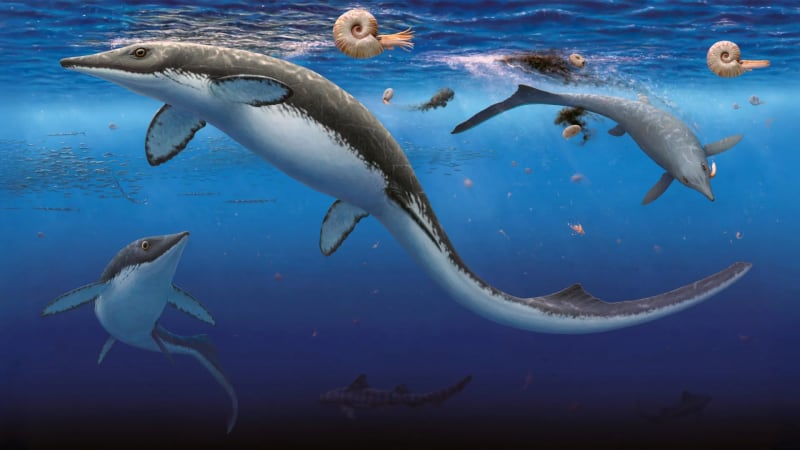
The fossil collection reveals an astonishing variety of marine life, including archosauromorphs (distant crocodile relatives) and numerous ichthyosaurs - 'fish-lizards' ranging from small, squid-hunting species less than 1 meter long to massive apex predators exceeding 5 meters. These ancient marine reptiles represent some of the earliest examples of land-based species successfully adapting to life far from shore, marking a critical turning point in vertebrate evolution.
The fossil evidence emerged from rock layers originally formed as soft seafloor mud in an ancient ocean spanning mid to high paleolatitudes, bordering the enormous Panthalassa Super-ocean. Scientists attribute the end-Permian extinction to extreme conditions including intense greenhouse effects, oceanic oxygen depletion, widespread acidification, and massive volcanic eruptions connected to the breakup of the Pangaean supercontinent.
This extraordinary discovery not only challenges existing scientific understanding but also celebrates the incredible adaptability and resilience of life on our planet. By revealing how rapidly and comprehensively marine ecosystems can recover from near-total destruction, the Spitsbergen fossils offer a message of hope and wonder about nature's extraordinary capacity for renewal and regeneration.
Based on reporting by Science Daily
This story was written by BrightWire based on verified news reports.
More Good News
 🌍 Planet
Killer Whales: Masters of Adaptation - How Orcas Are Revealing Remarkable Social Intelligence
 🌍 Planet
Global Communities Resilient in Face of Unprecedented 2025 Flooding Challenges
 🌍 Planet