Rare Bat Discovery Sparks Conservation Debate in Guinea's Biodiversity Hotspot
Scientists discover a stunning new bat species in Guinea's Nimba Mountains, raising critical questions about conservation and industrial development. The remarkable find highlights the delicate balance between mineral extraction and protecting our planet's most unique ecological habitats.
Deep within abandoned mine tunnels nestled high in Guinea's Nimba Mountains, scientists made a remarkable discovery that could reshape the future of an entire ecosystem. In 2018, a team of international researchers exploring old mining shafts not only uncovered a previously unknown bat species but also highlighted the delicate balance between industrial development and critical wildlife preservation.
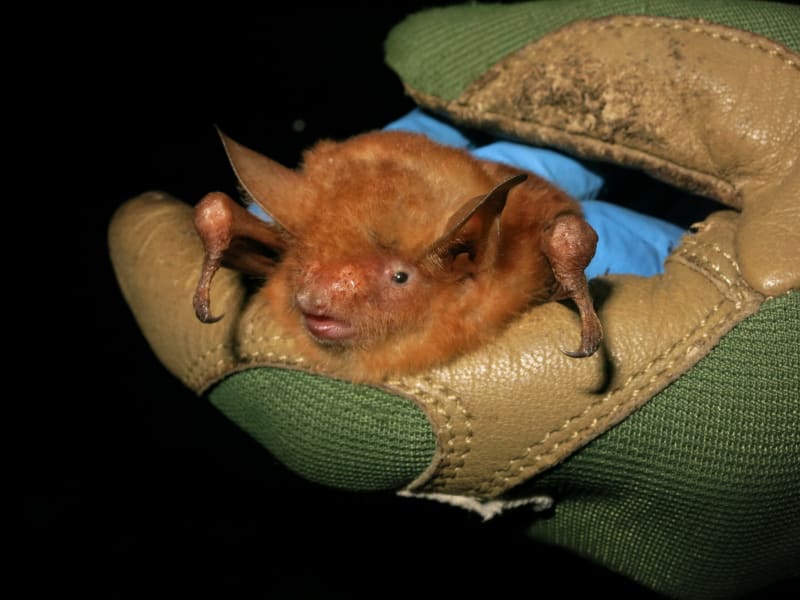
The groundbreaking expedition, led by researchers from Bat Conservation International, Cameroon's University of Maroua, and the American Museum of Natural History, was initially focused on understanding the habitat of the critically endangered Lamotte's roundleaf bat. During their exploration of horizontal shafts abandoned since the 1970s and '80s, they trapped and examined two individuals of a stunning new bat species with distinctive bright orange fur - the Myotis nimbaensis.
Local villagers had long reported sightings of an unusual orange-colored bat in the mountainous region approximately 1,400 meters above sea level, but this was the first formal scientific documentation. The researchers recorded echolocation sounds in five mine access tunnels that matched the vocalizations of this newly identified species, ultimately naming it to honor its mountain homeland.
However, this exciting scientific breakthrough arrives amidst significant environmental tension. U.S. mining company Ivanhoe Atlantic is seeking to develop an open-pit iron ore project in this UNESCO World Heritage Site, a move that conservationists argue could devastate the region's extraordinary biodiversity. The proposed Kon Kweni iron ore project threatens not just the newly discovered bat species, but also critically endangered western chimpanzees and unique amphibian species like the world's only true viviparous toad.
Jon Flanders, one of the biologists involved in the original research, eloquently captured the core challenge: "There is this huge clash: it's a real mineral-rich area, but also a world-renowned biodiversity hotspot." The Nimba mountain range represents an ecological treasure, spanning 175 square kilometers across Guinea, Liberia, and Côte d'Ivoire, hosting dozens of endemic species found nowhere else on Earth.
The Lamotte's roundleaf bat, a small brown-blackish insectivore with a distinctive round nose leaf, plays a crucial role in its ecosystem by providing natural pest control. Its constrained echolocation means that even minor habitat disruptions could have significant consequences for its survival. Ironically, the very mine tunnels these bats have adopted as roosting sites could be destroyed by the proposed development.
As Ivanhoe Atlantic's environmental impact assessment awaits government review, the scientific community and conservation organizations are raising urgent concerns. The discovery of the Myotis nimbaensis serves as a powerful reminder of how much remains unknown about our planet's biodiversity and the critical importance of preserving these fragile ecosystems before they are irreparably altered.
Based on reporting by Mongabay
This story was written by BrightWire based on verified news reports.
More Good News
 🌍 Planet
Global Communities Resilient in Face of Unprecedented 2025 Flooding Challenges
 🌍 Planet
Hope Springs: Five Wildlife Species Staging Remarkable Comebacks
 🌍 Planet