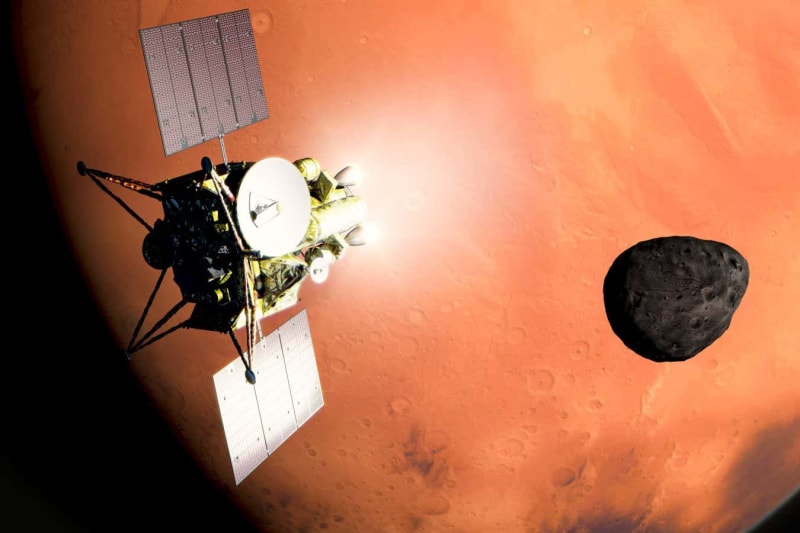
Japan's Bold Mission: Unraveling the Mystery of Mars' Enigmatic Moons
Japan's groundbreaking MMX spacecraft will launch in 2026 to investigate the mysterious origins of Mars' moons, potentially revealing crucial insights about the planet's ancient history. The mission could solve a decades-long astronomical puzzle by collecting and returning the first samples from Phobos.
In an extraordinary quest to solve one of the solar system's most intriguing puzzles, scientists are preparing to launch a groundbreaking spacecraft that could finally reveal the origin of Mars' mysterious moons, Phobos and Deimos.
The Martian Moons eXploration (MMX) spacecraft, set to launch after April 2026, represents humanity's most comprehensive attempt to understand how these celestial bodies came into existence around the Red Planet. With two competing theories on the table - either Mars captured nearby asteroids or the moons formed from a massive collision - researchers are eager to unlock this astronomical enigma.

Dr. Emelia Branagan-Harris from the Natural History Museum in London explains the significance: "We are sure about the origin of Earth's moon, but we don't know how Phobos and Deimos got there. Understanding their origins can tell us about Mars' broader evolutionary history."
The Japanese spacecraft will employ an impressive array of scientific instruments, including multiple cameras and spectrometers, to conduct detailed observations during its orbital mission in 2027. Most excitingly, the mission includes deploying a rover directly onto Phobos' surface to collect rock samples from both the surface and several centimeters beneath.

Scientists hope the samples, scheduled to return to Earth in 2031, will provide definitive evidence about the moons' formation. The presence of carbon-rich molecules and water could support the asteroid capture theory, while the absence might necessitate more complex analysis.
Beyond understanding the moons' origins, the mission holds another tantalizing possibility: Phobos might contain well-preserved fragments from Mars' ancient past. "There's potential that Phobos could have pieces of ancient Mars from when it had liquid water," Branagan-Harris notes, highlighting the mission's potential to unlock secrets about the planet's geological history.

As humanity continues to push the boundaries of space exploration, the MMX mission represents a remarkable convergence of technological innovation and scientific curiosity, promising to shed light on one of our solar system's most enduring mysteries.
Based on reporting by New Scientist
This story was written by BrightWire based on verified news reports.
Spread the positivity! 🌟
Share this good news with someone who needs it
More Good News
 🚀 Innovation
5 Breakthrough Innovations Transforming Outdoor Adventures in 2025
 🚀 Innovation
Scientists Unveil First Precisely Measured Rogue Planet Drifting Solo Through Space
 🚀 Innovation