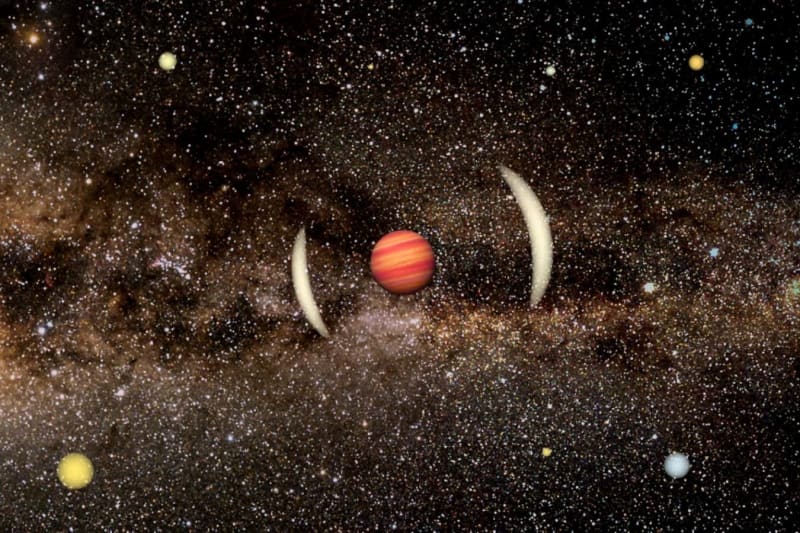
Scientists Unveil First Precisely Measured Rogue Planet Drifting Solo Through Space
Scientists have measured the mass of a rare Saturn-sized planet drifting alone through space, marking a groundbreaking moment in astronomical research. This discovery could transform our understanding of planetary formation and migration.
In a groundbreaking astronomical discovery, researchers have successfully measured the mass of a Saturn-sized planet wandering alone through the vast cosmic darkness, nearly 10,000 light years from Earth.
The mysterious celestial object, identified by two independent telescopic observations under the names KMT-2024-BLG-0792 and OGLE-2024-BLG-0516, represents a pivotal breakthrough in understanding planetary formation and migration.
Scientists utilized an extraordinary technique called gravitational microlensing to detect this rare wandering world. By observing how the planet's gravitational field bends light from a distant bright source, researchers created a unique cosmic "halo" effect that allowed precise mass calculations.
Gavin Coleman from Queen Mary University of London highlighted the significance of this discovery, noting that this is the first rogue planet with a confirmed mass measurement—approximately one-fifth the mass of Jupiter. The planet fills a critical size gap in previous observations that astronomers had dubbed the "Einstein desert".

Lead researcher Andrzej Udalski from the University of Warsaw emphasized that mass is the primary parameter for planetary classification, making this the first technically confirmed free-floating exoplanet. The discovery suggests that such planets might be far more numerous than previously understood.
Udalski believes these wandering planets could be crucial in understanding planetary system formation, potentially revealing insights into how planets like those in our own solar system are ejected during early developmental stages.

NASA's upcoming Nancy Grace Roman space telescope, scheduled for launch in 2027, is expected to dramatically expand our knowledge by discovering many more of these intriguing cosmic nomads, potentially revolutionizing our understanding of planetary dynamics.
Based on reporting by New Scientist
This story was written by BrightWire based on verified news reports.
Spread the positivity! 🌟
Share this good news with someone who needs it
More Good News
 🚀 Innovation
New Quiz App Turns Studying into an Exciting Game of Learning and Competition
 🚀 Innovation
Nigeria's Economic Rebound: From Challenges to Potential Breakthrough in 2026
 🚀 Innovation