Hidden Forest Guardian: New Frog Species Discovered in Peru's Cloud Forests Highlights Community Conservation
A remarkable new frog species, Oreobates shunkusacha, has been discovered in Peru's cloud forests through a collaborative effort between scientists and local communities. The tiny amphibian highlights both the region's incredible biodiversity and the urgent need for conservation.
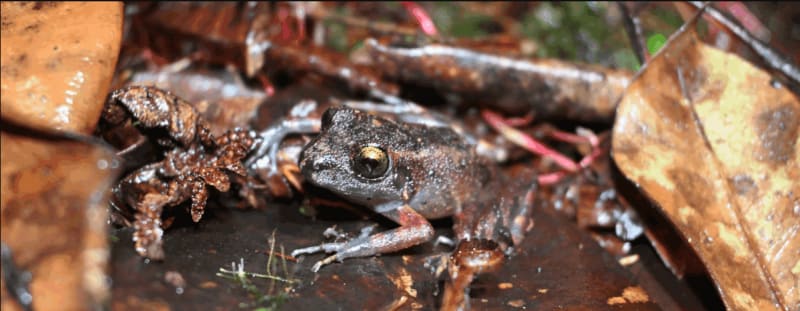
In the misty, remote cloud forests of Peru's San Martín region, a tiny amphibian has emerged as a symbol of biodiversity and hope—a newly discovered frog species that measures just 2-3 centimeters, with dark brown skin and mesmerizing golden irises.
Named Shunku Sacha, meaning "heart of the forest" in the Kichawa-Lamista language, the scientific name Oreobates shunkusacha represents more than just a biological discovery. It embodies a collaborative journey between Indigenous communities, local conservation groups, and international scientists who are working together to protect one of the world's most delicate ecosystems.
During expeditions in 2022 and 2025, researchers from Nature Conserv'Action and the Ararankha Association–Ecology and Conservation explored the Bosques de Vaquero Biocorridor, a protected region spanning approximately 8,000 hectares. Guided by 30 dedicated community volunteers, the scientific team uncovered this remarkable amphibian hidden among fallen leaves and lush forest undergrowth at elevations above 1,350 meters.
The frog's habitat is critically threatened, with the species already considered endangered due to its extremely limited range. Currently, O. shunkusacha is known only from two specific locations within the San Martín department: the Sacha Runa Conservation Concession in the Sauce district and the Yaku Kawsanapa Concession in the Chazuta district, both situated in the buffer zone of Cordillera Azul National Park.
Ernesto Castillo, a herpetologist and co-author of the study published in the German journal Salamandra, explained the unique ecological significance of the discovery: "Because these are isolated hills, they act like islands with unique ecosystems in which such species live." The research highlighted how local community knowledge was instrumental in identifying potential research areas, with residents actively participating in scientific methodologies and fieldwork.
Kenneth Mori Ríos, president of the Sacha Runa Ecological Association, expressed hope for the region's future: "The greatest challenge is ensuring the protection of the biocorridor. It's a dream we have: to see this entire area free from environmental crimes so that the species being discovered can endure over time."
At night, these remarkable frogs emerge to navigate through intricate forest landscapes—moving across leaf litter, moss, and ferns, occasionally making their way toward the enchanting high-mountain lake known as Cocha Encantada. Their discovery represents more than a scientific milestone; it's a testament to the power of collaborative conservation and the incredible biodiversity still waiting to be understood in our planet's most remote ecosystems.
Based on reporting by Mongabay
This story was written by BrightWire based on verified news reports.
More Good News
 🌍 Planet
Global Communities Resilient in Face of Unprecedented 2025 Flooding Challenges
 🌍 Planet
Hope Springs: Five Wildlife Species Staging Remarkable Comebacks
 🌍 Planet