Wearable Health Tech's Hidden Environmental Impact: A Breakthrough Study Reveals Surprising Solutions
A groundbreaking study reveals the hidden environmental impact of wearable healthcare electronics, offering innovative strategies to reduce their ecological footprint. Researchers project a 42-fold increase in device consumption by 2050 and provide a roadmap for sustainable technological design.
In a groundbreaking exploration of modern healthcare technology, researchers have uncovered critical insights into the environmental footprint of wearable medical devices, revealing both challenges and innovative pathways for sustainable innovation.
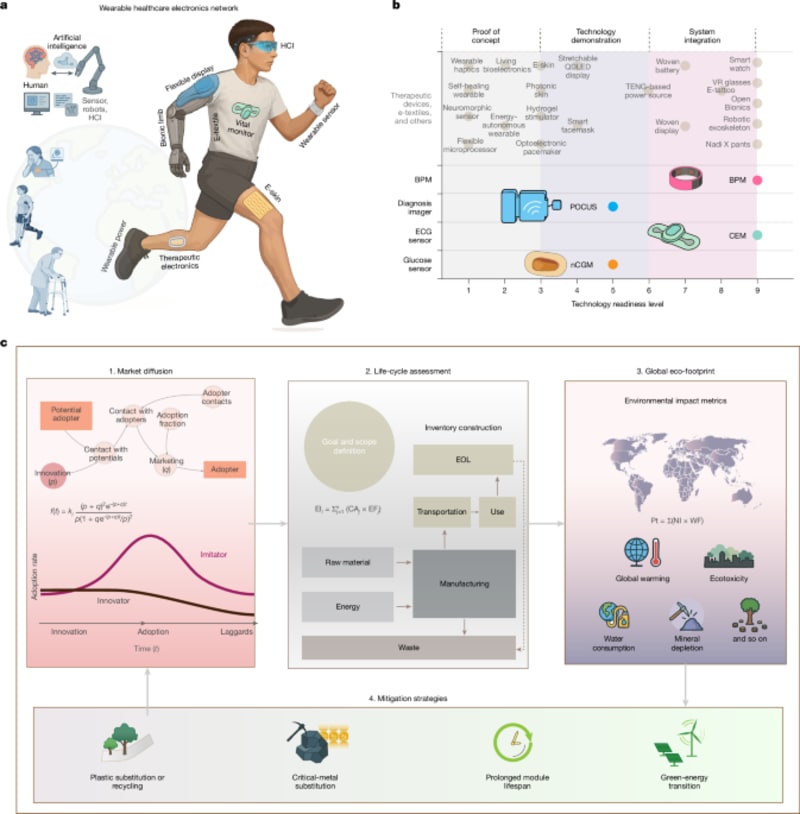
The comprehensive study examines the ecological implications of healthcare electronics like glucose monitors, cardiac devices, and diagnostic imaging tools, projecting a dramatic 42-fold increase in global device consumption by 2050 - potentially reaching nearly 2 billion units annually.
Scientists discovered that these devices generate between 1.1 and 6.1 kilograms of CO2-equivalent emissions per unit, presenting a significant environmental challenge. Contrary to conventional sustainability approaches focusing on plastics, the research demonstrates that true ecological improvement lies in reimagining circuit architectures and replacing critical-metal conductors.
The integrated systems engineering framework developed by the research team provides a comprehensive cradle-to-grave analysis, offering unprecedented insights into potential mitigation strategies. By systematically mapping environmental impact hotspots, researchers can now guide manufacturers toward more responsible design practices without compromising device performance.
Projected environmental consequences are substantial: by 2050, wearable healthcare electronics could generate approximately 3.4 megatons of CO2-equivalent emissions, alongside potential ecotoxicity and electronic waste concerns. This stark projection underscores the urgent need for innovative, environmentally conscious design strategies in the rapidly expanding digital health sector.
The study's most revolutionary finding challenges traditional sustainability approaches by revealing that recyclable or biodegradable plastics offer only marginal environmental benefits. Instead, the research points to optimizing circuit architectures and strategically substituting critical-metal conductors as more impactful strategies for reducing ecological impact.
This pioneering research represents a significant step toward establishing ecologically responsible innovation in next-generation wearable electronics, demonstrating how technological advancement and environmental stewardship can work hand-in-hand to create more sustainable healthcare solutions.
Based on reporting by Nature News
This story was written by BrightWire based on verified news reports.
Spread the positivity! 🌟
Share this good news with someone who needs it
More Good News
 🌍 Planet
Eden Project Founder Reveals Optimism: World is Improving, Not Declining
 🌍 Planet
The Ultimate Green Goodbye: How Your Final Resting Choice Impacts Earth
 🌍 Planet