The Robot Revolution: How China Could Lead the Next Tech Transformation
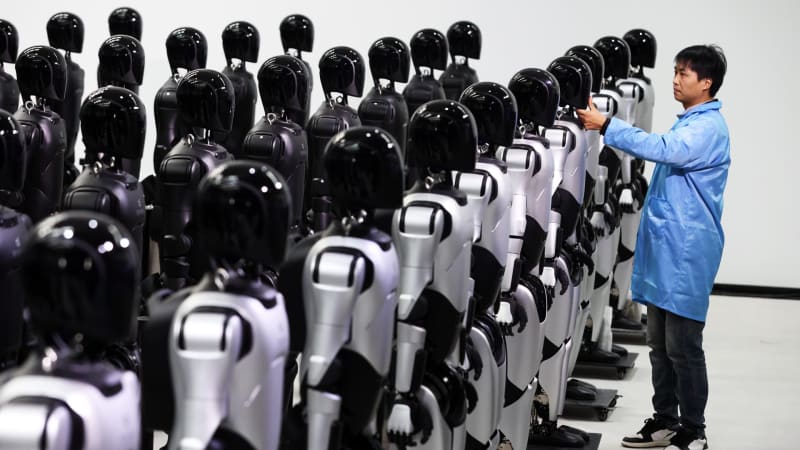
China is emerging as a global leader in humanoid robotics, with ambitious plans to transform industries and address labor challenges. Pioneering companies like Unitree and UBTech are set to dramatically scale robot production by 2026.
A new technological frontier is emerging, and it looks remarkably human-like. Elon Musk's vision of humanoid robots might soon become reality, but surprisingly, China appears poised to lead the global charge in robotic innovation.
Tesla's billionaire CEO has been vocal about humanoid robots, positioning them as a potential game-changer for the company's future valuation. However, while Tesla's flagship Optimus robot remains in development, Chinese companies are rapidly advancing their own robotic technologies, with plans to ramp up production as early as 2026.
Industry experts are taking notice of China's strategic approach. Andreas Brauchle from consultancy Horváth stated definitively that China currently leads the United States in early humanoid robot commercialization. These sophisticated machines, powered by complex artificial intelligence algorithms and advanced semiconductors, could potentially transform industries ranging from manufacturing to hospitality.
China's robotics push is multifaceted, addressing critical national challenges. With declining birth rates and an aging population creating workforce pressures, humanoid robots represent a potential solution to labor shortages. The country's leadership, including President Xi Jinping, has explicitly highlighted 'embodied artificial intelligence' as a key strategic priority in their latest five-year planning document.
Several Chinese robotics firms are emerging as global leaders. Unitree, valued around $7 billion, has already demonstrated impressive capabilities, including a humanoid model that can dance. UBTech Robotics offers both industrial and commercial robots, with their Walker S2 model capable of autonomous battery replacement to enable 24-hour operation. The company plans an ambitious production scale-up, targeting 500 industrial robots this year and 5,000 humanoid robots by 2026.
The global market potential is staggering. RBC Capital Markets forecasts a $9 trillion addressable market for humanoid robots by 2050, with China expected to capture over 60% of that value. This projection underscores the strategic importance of robotics in the ongoing technological competition between China and the United States.
As the robotics race accelerates, both nations are positioning themselves strategically. The U.S. Commerce Secretary has been meeting with robotics company CEOs, and Washington is reportedly considering an executive order to support industry development. Meanwhile, China continues to view humanoid robotics as a critical avenue for economic growth and technological supremacy.
The emerging robot revolution represents more than just technological innovation – it signals a fundamental reimagining of work, assistance, and human-machine interaction. As Chinese companies push the boundaries of what's possible, the world watches with a mixture of excitement and anticipation, wondering how these human-like machines will reshape our collective future.
Based on reporting by CNBC
This story was written by BrightWire based on verified news reports.
More Good News
 🚀 Innovation
China Revives Car Trade-In Subsidies to Boost Automotive Market
 🚀 Innovation
China's Groundbreaking Hypergravity Lab Unveils Revolutionary Scientific Research Capabilities
 🚀 Innovation