Scientists Uncover Potential Breakthrough in Dark Matter Research Through Fusion Reactors
Scientists propose a revolutionary method for generating dark matter particles inside fusion reactors, bridging theoretical physics and cutting-edge research. The study offers a potential breakthrough in understanding the universe's most mysterious form of matter.
In a groundbreaking development that bridges theoretical physics and cutting-edge research, scientists have proposed an innovative method for potentially creating elusive dark matter particles inside fusion reactors - a challenge that even the fictional physicists from 'The Big Bang Theory' couldn't crack.
University of Cincinnati physicist Jure Zupan and an international team of collaborators have published a promising study in the Journal of High Energy Physics detailing how fusion reactors might generate axions, theoretical subatomic particles that could help explain the mysterious dark matter that shapes our universe. Their research builds upon decades of scientific curiosity about the invisible matter that comprises most of the universe's mass, yet remains undetectable through traditional observation methods.
Dark matter, which makes up the majority of matter in the universe, has long puzzled scientists because it does not absorb or reflect light. Its existence is primarily inferred through gravitational effects - the unusual motions of galaxies and stars suggest the presence of unseen mass exerting significant gravitational pull. One leading hypothesis proposes that dark matter consists of extremely light particles called axions, and Zupan's team believes fusion reactors might provide a unique pathway to understanding these enigmatic particles.
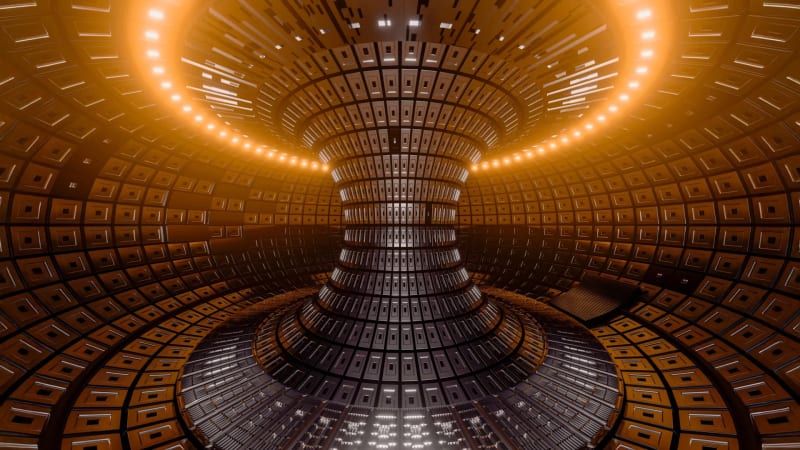
The researchers examined a specific fusion reactor design utilizing deuterium and tritium fuel within a lithium-lined vessel - an international project currently under development in southern France. This reactor would generate massive numbers of neutrons, which could potentially create particles linked to the mysterious 'dark sector' through complex nuclear interactions. As neutrons interact with reactor wall materials and collide with other particles, they could theoretically produce axions through processes like bremsstrahlung, or 'braking radiation'.
Interestingly, the research includes a delightful connection to popular culture. The study references 'The Big Bang Theory', a television show that featured fictional physicists Sheldon Cooper and Leonard Hofstadter wrestling with similar scientific challenges. The show even included subtle scientific Easter eggs, such as whiteboards displaying complex equations about axion production that went unexplained to most viewers but served as inside jokes for scientific audiences.
While the chances of detecting axions from fusion reactors are potentially lower compared to solar production, Zupan emphasizes that alternative processes could still yield groundbreaking discoveries. The sun, being a massive power-generating object, naturally has a higher probability of producing detectable particles. However, the fusion reactor approach represents an exciting new frontier in dark matter research, offering scientists another potential window into understanding the fundamental structures of our universe.
This innovative research highlights the remarkable progress of modern physics, where theoretical concepts once confined to television shows and academic discussions are now being seriously investigated as potential scientific breakthroughs. By exploring unconventional methods of particle generation, researchers like Zupan are pushing the boundaries of human knowledge and bringing us closer to comprehending the profound mysteries that surround us.
Based on reporting by Science Daily
This story was written by BrightWire based on verified news reports.
More Good News
 🚀 Innovation
Electrifying Deal: Dodge Charger EV Slashes Prices by Nearly 50%
 🚀 Innovation
CATL's Sodium-Ion Battery Revolution: A Breakthrough in Electric Vehicle Technology
 🚀 Innovation
Home Tech Revolution: 5 Breakthrough Innovations That Are Changing Everyday Living
Start Your Day With Good News
Join 50,000+ readers who wake up to stories that inspire. Delivered fresh every morning.
No spam, ever. Unsubscribe anytime.