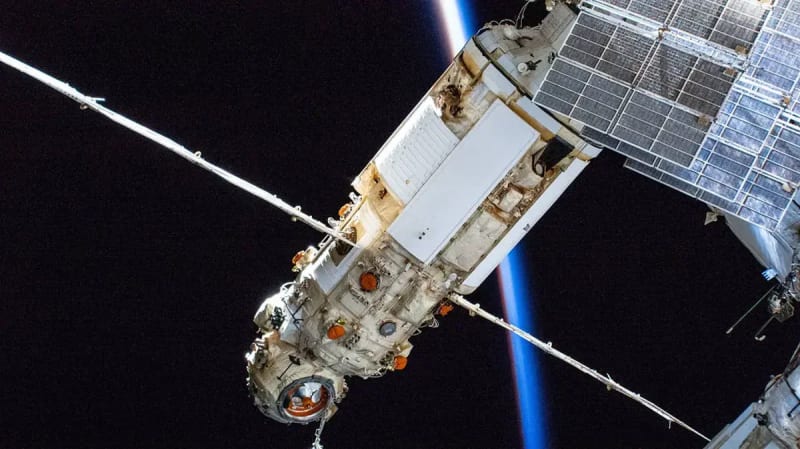
Russia Rethinks Space Station Strategy, Signals Potential International Collaboration
Russia is reimagining its space station strategy, opting for a familiar orbit and potentially signaling new international collaborations. The decision reflects economic realities and could pave the way for future joint space exploration efforts.
In a significant shift for its space program, Russia has quietly revised its ambitious plans for a future orbital laboratory, choosing a more pragmatic approach that could open doors to international partnerships.
The Russian Orbital Station (ROS), originally conceived with bold plans for a polar orbit, will now follow the familiar trajectory of the International Space Station (ISS), a decision with far-reaching implications for the country's space exploration strategy. This unexpected pivot comes as the ISS is slated to conclude operations by 2030, leaving a critical gap in international space research.
Roscosmos General Director Dmitry Bakanov framed the decision as a potential collaboration opportunity with India, noting that both nations are developing their own national orbital stations. During a visit to New Delhi, Bakanov suggested the possibility of placing their stations in the same orbital plane, a statement that hints at broader diplomatic and technological cooperation.
However, space experts like Dmitry Payson from the International Academy of Astronautics view the change through a more pragmatic lens. The new orbit selection is primarily driven by economic considerations, offering significant cost savings and allowing Russia to leverage existing spacecraft designs and technologies from the ISS and Soyuz programs. "This decision is entirely understandable given the political and economic realities," Payson explained, suggesting that the potential alignment with India serves more as a convenient justification than a primary motivation.
The shift represents a notable departure from earlier ambitious plans. In 2014, then-Roscosmos head Oleg Ostapenko had envisioned a high-latitude station capable of observing most of Russia's territory and potentially serving as a launch point for lunar missions. Initial concepts included innovative modules like the OKA-T for advanced materials science and an expandable module with a centrifuge, positioning the station as a testbed for future lunar infrastructure.
By 2021, many of these forward-looking designs had been scaled back. The station will now be centered around the Science Power Module (NEM), a pre-existing module from RKK Energia that was originally intended to reduce the Russian segment's dependence on U.S. power systems. This pragmatic approach means the new Russian Orbital Station looks more like a return to the Mir-era design than a leap into a bold new future.
Interestingly, polar orbits remain rare in human spaceflight. To date, the only crewed mission to achieve such an orbit was the privately funded Fram2 flight on a SpaceX Dragon capsule in April 2025, underscoring the technical challenges of such trajectories. Russia's decision to maintain the familiar 51.6-degree inclination used by previous space stations reflects both technological and economic constraints in the current space exploration landscape.
Based on reporting by Scientific American
This story was written by BrightWire based on verified news reports.
More Good News
 🚀 Innovation
Electrifying Deal: Dodge Charger EV Slashes Prices by Nearly 50%
 🚀 Innovation
CATL's Sodium-Ion Battery Revolution: A Breakthrough in Electric Vehicle Technology
 🚀 Innovation
Home Tech Revolution: 5 Breakthrough Innovations That Are Changing Everyday Living
Start Your Day With Good News
Join 50,000+ readers who wake up to stories that inspire. Delivered fresh every morning.
No spam, ever. Unsubscribe anytime.