Revolutionary DNA Storage System Promises Millennia of Data Preservation in Tiny Liquid Form
A breakthrough DNA storage system can compress 10 billion songs into a single liter of liquid, offering unprecedented data preservation potential. This innovative technology promises to transform digital archiving for centuries to come.
In a groundbreaking leap for digital archiving, Atlas Data Storage has unveiled a synthetic DNA storage system that could transform how humanity preserves its most precious digital memories and critical information.
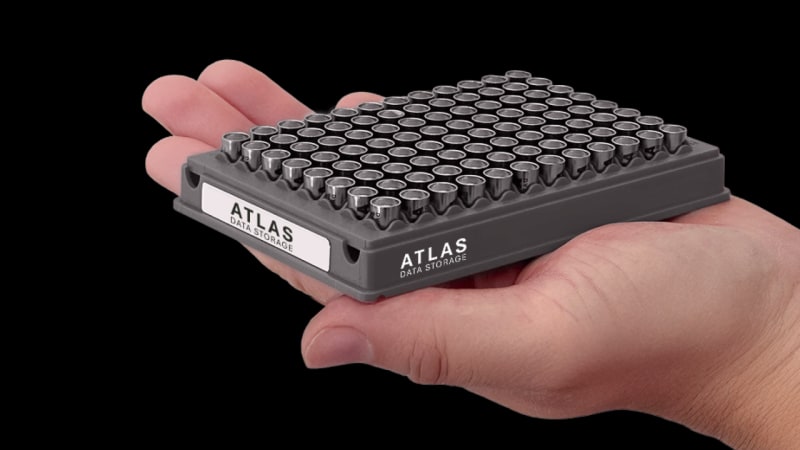
The Atlas Eon 100, announced on December 2nd, represents over a decade of multidisciplinary research and innovation. Founded by Bill Banyai, the company aims to create an unprecedented solution for long-term data preservation that can store an astounding 60 petabytes - equivalent to 10 billion songs or 12 million high-definition movies - in just one liter of liquid.
At the core of this technology is a sophisticated method of converting digital binary code into DNA's chemical bases: adenine, cytosine, guanine, and thymine. By mapping 1s and 0s to these bases using a precise encoding scheme, scientists can synthesize artificial DNA strands that contain massive amounts of information. The DNA is then dehydrated into a powder and stored in compact, ruggedized steel capsules measuring just 0.7 inches tall.
The storage potential of this system is remarkable. Where traditional magnetic tape would require approximately 15,500 miles of half-inch-wide storage medium to hold the same data, Atlas Eon 100 can compress that information into a container small enough to fit in a human hand. The system boasts an extraordinary 99.99999999999% reliability and can maintain data integrity in office environments and temperatures up to 104°F.
Compared to existing storage technologies, DNA offers unprecedented longevity. While hard drives typically last 6-7 years, optical media degrades within 30 years, and magnetic tape decays in about a decade, DNA can potentially preserve information for centuries. This makes it an ideal medium for archiving humanity's most irreplaceable digital assets: scientific data, family photographs, cultural artifacts, and master versions of artistic works.
However, the technology is not without challenges. Current DNA synthesis processes are time-consuming, with lead times ranging from 2 to 8 business days. Sequencing remains expensive, costing approximately $30 to read one gigabase of data, and file recovery can take significant time. Despite these obstacles, Atlas Data Storage remains optimistic, pointing to continuous improvements in DNA sequencing technology.
As global data generation reaches 280 petabytes every minute - a number dramatically accelerated by artificial intelligence - innovative storage solutions like the Atlas Eon 100 represent a critical technological advancement. By offering a stable, compact, and potentially centuries-long preservation method, this DNA storage system could revolutionize how we safeguard humanity's digital heritage for future generations.
Based on reporting by Live Science
This story was written by BrightWire based on verified news reports.
More Good News
 🚀 Innovation
China's Groundbreaking Hypergravity Lab Unveils Revolutionary Scientific Research Capabilities
 🚀 Innovation
Hope Rises: High-Tech Search Aims to Solve MH370 Mystery After Twelve Years
 🚀 Innovation