Out of This World: The Most Breathtaking Space Photos of 2025 Revealed
2025's most extraordinary space photographs reveal the universe's hidden beauty, captured by talented astrophotographers using cutting-edge technology. These images transform complex astronomical phenomena into stunning visual experiences that connect humanity with the cosmic landscape.
The cosmos never fails to astound, and 2025 has proven once again that the universe is a canvas of unimaginable beauty and complexity. Through the keen eyes and sophisticated equipment of dedicated astrophotographers, humanity has captured glimpses of celestial wonders that stretch the boundaries of human perception.
While our natural vision is limited, technology now allows us to peer into the most intricate details of space, revealing phenomena that would otherwise remain invisible. From solar prominences dancing above the sun's surface to distant nebulae shaped like cosmic creatures, this year's collection of space images represents a stunning testament to human curiosity and technological innovation.
Among the most remarkable images is Mark Johnston's extraordinarily detailed photograph of hydrogen plasma suspended in the sun's magnetic field, captured from Willow Springs, Arizona using a specialized TEC160FL refractor telescope. Johnston's image reveals the complex structures typically hidden from the naked eye, showcasing the intricate dynamics of our nearest star.
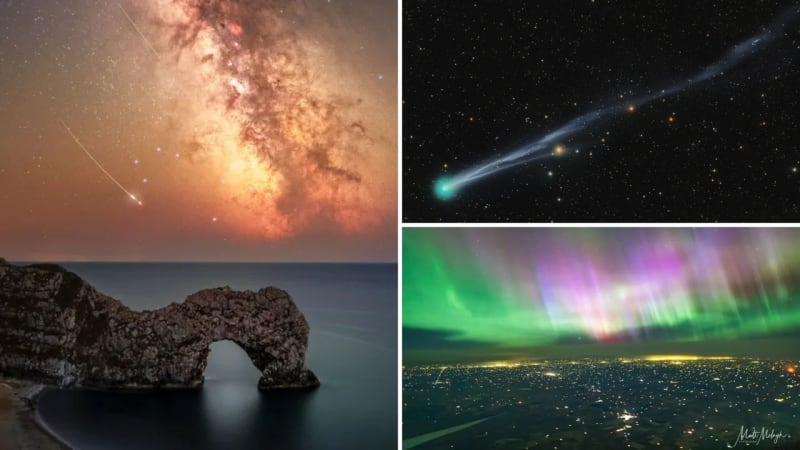
The year also saw spectacular cometary displays, with astrophotographer Dan Bartlett capturing an exceptional image of comet C/2025 A6 (LEMMON) over June Lake, California. The comet's tail, twisted by relentless solar winds, provided a dramatic celestial spectacle that reminded viewers of the dynamic nature of our solar system.
Some of the most captivating images weren't just of distant objects, but phenomena closer to home. Airline pilot Matt Melnyk captured a breathtaking view of the northern lights from 36,000 feet during a transatlantic flight, while Valter Binotto documented an ultra-rare 'elve' lightning phenomenon over the Italian Alps – a spectacle lasting less than a thousandth of a second and potentially spanning 300 miles in diameter.
Particularly stunning was Josh Dury's composite image of the Perseid meteor shower streaking across the Milky Way above England's iconic Durdle Door, and another remarkable solar eclipse composition featuring the ancient Stonehenge monument. These images not only showcase astronomical events but also connect celestial phenomena with Earth's most iconic landscapes.
Other remarkable captures included Daniele Gasparri's image of comet C/2025 R2 (SWAN) passing the Eagle Nebula, complete with the famous Pillars of Creation, and Osama Fathi's haunting 'Blood Moon' rising over Egypt's ethereal White Desert. Each photograph represents not just technical skill, but a profound human desire to understand and appreciate the vast, mysterious universe surrounding us.
As technology continues to advance, astrophotography offers an increasingly intimate window into the cosmos, transforming complex scientific observations into accessible, breathtaking art that inspires wonder and curiosity about our place in the universe.
Based on reporting by Space.com
This story was written by BrightWire based on verified news reports.