Nature's Masterpiece: Where Glacier, Lake, and River Converge in Patagonian Splendor
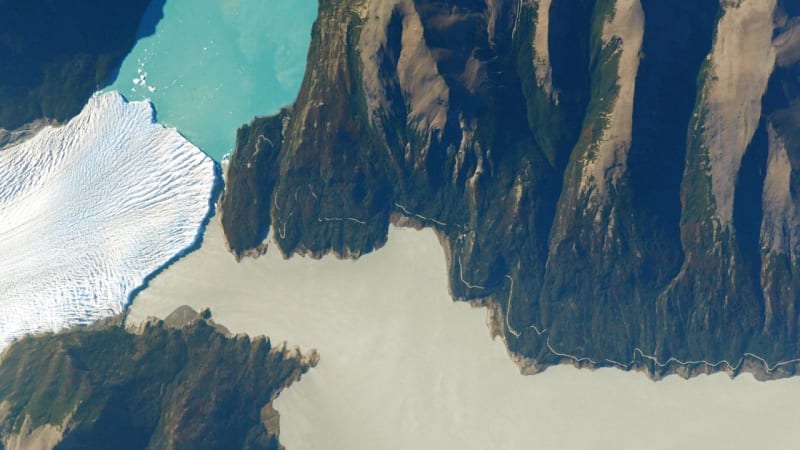
An astronaut's photograph captures the extraordinary moment where a glacier, lake, and river intersect in Argentina's Los Glaciares National Park. This stunning image reveals the dynamic, ever-changing nature of our planet's most remarkable geological landscapes.
High above Earth's surface, an astronaut captured a breathtaking moment of geological poetry - the precise intersection where a massive glacier, a luminous turquoise lake, and a sediment-rich river embrace in southern Argentina's Los Glaciares National Park. The photograph, taken on March 2, 2021, from the International Space Station, reveals a stunning geographic confluence that represents one of our planet's most remarkable natural choreographies.
Located in Santa Cruz province near the Chilean border, this extraordinary landscape encompasses the Perito Moreno Glacier, Lago Argentino, and Brazo Rico - a trio of hydrological wonders spread across approximately 2,300 square miles of pristine wilderness. What makes this location truly extraordinary is the slim channel where these three distinct water bodies touch, creating a visual masterpiece that challenges our understanding of natural boundaries.
The Perito Moreno Glacier stands as a geological marvel, stretching approximately 19 miles long with ice reaching up to 200 feet thick. Scientists estimate this remarkable formation contains water equivalent to 360,000 Olympic swimming pools - a statistic that underscores its immense scale. Perhaps most remarkably, Perito Moreno remains a rare 'non-retreating' glacier, maintaining its mass despite global climate changes that have caused many similar formations to shrink dramatically.
Lago Argentino, Argentina's largest freshwater lake, adds another layer of complexity to this natural tableau. Covering roughly 550 square miles, its southernmost arm appears in the astronaut's photograph, filled with 'glacier milk' - a scientific term describing the rocky particles released by glacial movement that gives the water its distinctive turquoise hue. The lake's intricate relationship with surrounding glaciers creates a dynamic ecosystem that continuously reshapes itself.
Every four to five years, the Perito Moreno Glacier performs a spectacular geological dance, extending its icy tongue to collide with the Magallanes Peninsula. This collision temporarily dams the Brazo Rico, causing water levels to rise dramatically - up to 100 feet - before a dramatic rupture releases immense pent-up pressure. This cyclical phenomenon highlights the powerful, ever-changing nature of our planet's geological systems.
The Brazo Rico, meaning 'rich arm' in Spanish, exhibits fascinating characteristics resulting from repeated glacial damming. Its murky green color stems from extensive sediment displacement, and the constant water level fluctuations have carved a unique landscape where vegetation struggles to take root. This ongoing transformation serves as a living testament to the persistent power of natural forces.
While the photograph captures a moment of seeming stillness, it represents a complex, dynamic system continuously evolving. Recent studies suggest that even the resilient Perito Moreno Glacier may finally be showing signs of retreat, reminding us of the delicate balance within our planet's most extraordinary ecosystems. This single image from space offers more than a beautiful vista - it provides a profound glimpse into Earth's intricate, interconnected natural processes.
Based on reporting by Live Science
This story was written by BrightWire based on verified news reports.