NASA's Budget-Friendly Mars Mission Proves Science Can Thrive on Innovation
NASA's ESCAPADE mission launches a revolutionary approach to planetary exploration, proving that innovative, low-cost strategies can unlock extraordinary scientific discoveries. By embracing risk and leveraging commercial partnerships, space research enters an exciting new era.
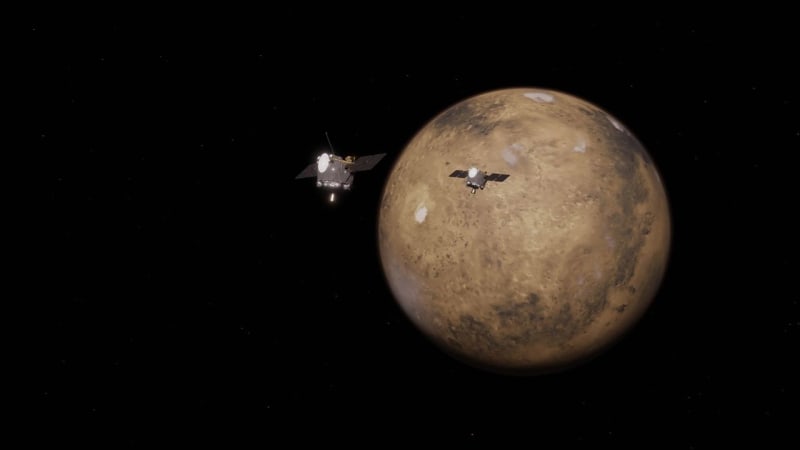
In a groundbreaking moment for space exploration, NASA's ESCAPADE mission launched on November 13, 2025, representing a bold new approach to planetary research that could reshape how we explore the cosmos. Two compact probes, developed through an innovative low-cost strategy, will soon map Mars' magnetic field and investigate how solar winds have systematically stripped away the planet's atmosphere over billions of years.
The mission, part of NASA's Small Innovative Missions for Planetary Exploration (SIMPLEx) program, embodies a daring philosophy of achieving scientific breakthroughs with limited resources. Costing an estimated $94.2 million by 2029, ESCAPADE demonstrates how strategic cost-cutting and collaborative partnerships can unlock new frontiers of astronomical understanding.
Classified as a high-risk, class D mission, ESCAPADE represents a significant departure from traditional, meticulously managed space projects. Of the 21 class D missions launched since 2009, none have previously launched on schedule, and four were canceled entirely. Yet this mission embraces uncertainty, utilizing commercial off-the-shelf components, lightweight spacecraft design, and strategic outsourcing to private companies like Rocket Lab and Advanced Space LLC.
The mission's development involved creative financing strategies, including a university-funded camera package and a discounted launch aboard Blue Origin's New Glenn rocket. By leveraging commercial space sector innovations and maintaining tight budget constraints, NASA is pioneering a more agile approach to planetary exploration that could revolutionize scientific research.
This approach emerges during a critical transition in space science, where agencies face unprecedented budget pressures and political funding shifts toward human spaceflight. The 'faster, better, cheaper' philosophy—which originally emerged in the 1980s and 1990s—is experiencing a renaissance, driven by technological advances and a more entrepreneurial spirit in space exploration.
For researchers like the article's author, who helped develop the VISIONS camera systems aboard ESCAPADE's spacecraft, the mission represents more than a scientific endeavor—it symbolizes hope and innovation. If successful, ESCAPADE could prove that calculated risk-taking and collaborative innovation can deliver profound scientific insights without astronomical costs.
As ESCAPADE begins its 30-month journey to scientific discovery, it carries with it the aspirations of a new generation of space explorers. By challenging traditional mission parameters and embracing a more flexible, cost-effective approach, NASA is demonstrating that groundbreaking science doesn't always require groundbreaking budgets.
Based on reporting by Space.com
This story was written by BrightWire based on verified news reports.
More Good News
 🚀 Innovation
Electrifying Deal: Dodge Charger EV Slashes Prices by Nearly 50%
 🚀 Innovation
CATL's Sodium-Ion Battery Revolution: A Breakthrough in Electric Vehicle Technology
 🚀 Innovation
Home Tech Revolution: 5 Breakthrough Innovations That Are Changing Everyday Living
Start Your Day With Good News
Join 50,000+ readers who wake up to stories that inspire. Delivered fresh every morning.
No spam, ever. Unsubscribe anytime.