James Webb Telescope Unveils Cosmic Mystery: The Star-Forming Powerhouse of Sagittarius B2
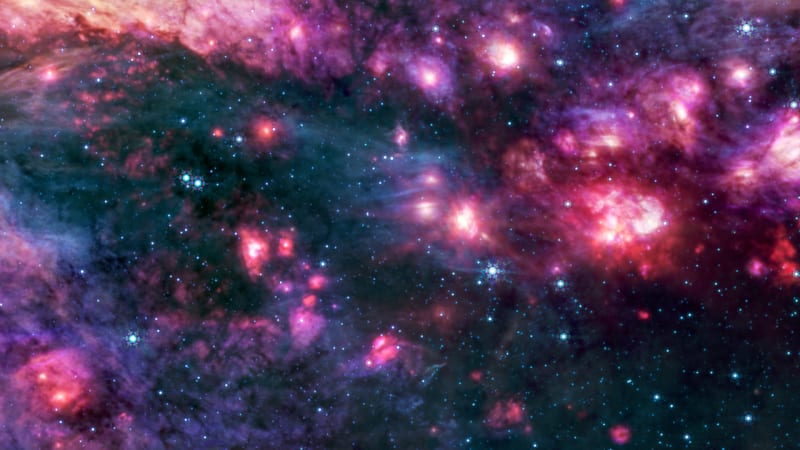
The James Webb Space Telescope has captured a stunning image of the Sagittarius B2 molecular cloud, revealing a cosmic powerhouse that defies traditional understanding of star formation. This extraordinary region challenges our knowledge of galactic dynamics and offers unprecedented insights into stellar creation.
In the vast, intricate canvas of our Milky Way, a colossal molecular cloud is rewriting the rules of stellar creation, and the James Webb Space Telescope has just captured its breathtaking portrait. The Sagittarius B2 (Sgr B2) molecular cloud, located a staggering 26,000 light-years from Earth, represents one of the most fascinating astronomical enigmas of our time.
Stretching an incredible 150 light-years across, this cosmic behemoth weighs between 3 million and 10 million times the mass of our sun, making it a true giant among molecular clouds. What makes Sgr B2 truly remarkable is its extraordinary ability to generate stars - producing an astonishing 50% of the stars in the galaxy's central region, despite containing just 10% of the available gas.
The James Webb Space Telescope's Mid-Infrared Instrument (MIRI) captured a stunning image that reveals the cloud's complex structure, with glowing clumps of dust and gas appearing in mesmerizing shades of pink, purple, and red. Surrounding these luminous regions are dark areas, not signifying emptiness, but rather areas where dense dust blocks light detection, creating an almost mysterious astronomical landscape.
Astronomers are particularly intrigued by the cloud's right-side regions, which appear redder and represent one of the most chemically complex areas ever observed. Previous telescope studies have hinted that this unique section might hold critical insights into the cloud's exceptional star-formation efficiency, presenting a tantalizing scientific puzzle waiting to be unraveled.
The telescope's simultaneous near-infrared and mid-infrared imaging provides scientists with a comprehensive view of this stellar factory. While the mid-infrared image shows warm dust and gas with only the brightest stars, the near-infrared view reveals a stunning abundance of stellar bodies, offering researchers a multi-wavelength perspective on this extraordinary cosmic region.
By conducting in-depth analyses of the masses and ages of stars within Sagittarius B2, scientists hope to unlock fundamental mysteries about star formation mechanisms in the Milky Way's central regions. This research could provide groundbreaking insights into how stars are born and evolve in one of the most dynamic areas of our galaxy.
The James Webb Space Telescope continues to prove itself as an unparalleled tool for astronomical discovery, peeling back the cosmic curtain and revealing the intricate, beautiful processes that shape our universe. Sagittarius B2 stands as a testament to the complexity and wonder of stellar evolution, inviting us to marvel at the incredible mechanisms driving cosmic creation.
Based on reporting by Live Science
This story was written by BrightWire based on verified news reports.
More Good News
 🚀 Innovation
Electrifying Deal: Dodge Charger EV Slashes Prices by Nearly 50%
 🚀 Innovation
CATL's Sodium-Ion Battery Revolution: A Breakthrough in Electric Vehicle Technology
 🚀 Innovation
Home Tech Revolution: 5 Breakthrough Innovations That Are Changing Everyday Living
Start Your Day With Good News
Join 50,000+ readers who wake up to stories that inspire. Delivered fresh every morning.
No spam, ever. Unsubscribe anytime.