How Richard Feynman's Tiny Dream Launched a Scientific Revolution
On a crisp December day in 1959, physicist Richard Feynman delivered a lecture that would fundamentally reshape scientific understanding of the microscopic world. His visionary talk at Caltech planted the seeds for nanotechnology, decades before the term even existed.
When Richard Feynman stepped onto the stage at the California Institute of Technology on December 29, 1959, few could have predicted he was about to dream up an entirely new scientific frontier. His lecture, provocatively titled 'Plenty of Room at the Bottom,' would become a landmark moment in scientific imagination, challenging researchers to think smaller than ever before.
Feynman wasn't content with mundane miniaturization tricks like writing the Lord's Prayer on a pin. Instead, he boldly suggested scientists could potentially inscribe entire 24-volume encyclopedias on a pinhead, with room to spare for legible text. 'It is a staggeringly small world that is below,' he proclaimed, hinting at possibilities that seemed like pure science fiction at the time.
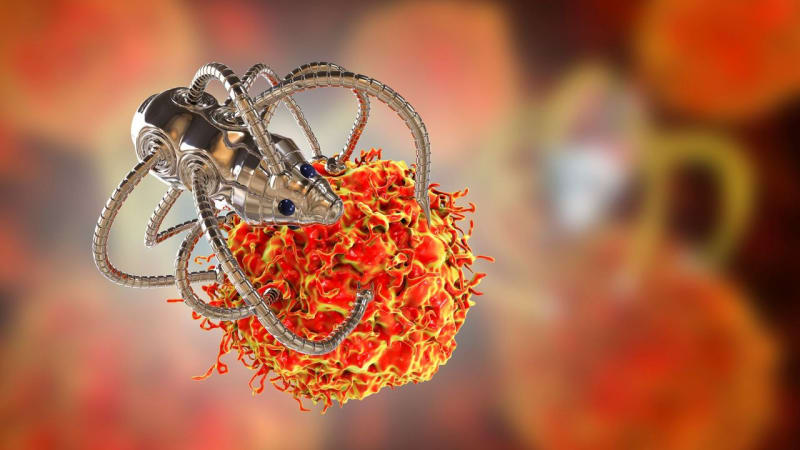
The visionary physicist outlined a series of then-futuristic concepts that now seem remarkably prophetic: electron microscopes capable of manipulating individual atoms, ultracompact data storage, miniature computers, and even microscopic medical machines that could travel into human organs, detecting and repairing defects with tiny surgical instruments. To incentivize innovation, Feynman offered two $1,000 prizes: one for miniaturizing text 25,000-fold and another for creating a motor smaller than 1/64th of an inch cubed.
The first prize caught the imagination of scientists worldwide, but it wasn't claimed until 1985 when Stanford graduate Thomas Newman miniaturized the first page of Charles Dickens' 'A Tale of Two Cities.' The motor challenge was more quickly met, with engineer William McLellan creating a 250-microgram motor composed of just 13 parts in 1960. Feynman playfully warned McLellan not to start 'writing small' and potentially claim the text miniaturization prize too, joking that he had recently married and bought a house and couldn't afford another reward.
Interestingly, the term 'nanotechnology' wasn't coined until 15 years after Feynman's lecture, when scientist Norio Taniguchi described it as 'the processing of separation, consolidation, and deformation of materials by one atom or one molecule.' Some science historians argue that the field was already developing independently, noting that prior to 1980, Feynman's talk was cited fewer than ten times.
Yet the lecture's lasting impact is undeniable. By 1990, scientists had used scanning tunneling microscopes to manipulate individual xenon atoms. Today, computers more powerful than Feynman could have imagined fit in our pockets, and nanobots capable of repairing damaged blood vessels are a reality. Richard Feynman's radical vision transformed how we understand the microscopic world, proving that true scientific innovation begins with the audacity to imagine the impossible.
Based on reporting by Live Science
This story was written by BrightWire based on verified news reports.
More Good News
 🚀 Innovation
China's Groundbreaking Hypergravity Lab Unveils Revolutionary Scientific Research Capabilities
 🚀 Innovation
From Sci-Fi to Science: UK Company Pioneers Manufacturing in Space
 🚀 Innovation