How One Physicist's Wild Vision Launched a Technological Revolution
In a groundbreaking 1959 lecture, physicist Richard Feynman envisioned a microscopic technological frontier that would eventually become nanotechnology. His radical ideas about manipulating matter at the atomic scale have since transformed multiple scientific disciplines.
In the crisp winter of 1959, physicist Richard Feynman stepped onto the stage at California Institute of Technology and delivered a lecture that would forever change how humanity perceives the microscopic world. With his characteristic blend of intellectual daring and playful curiosity, Feynman unveiled a revolutionary concept that would eventually birth an entire scientific discipline: nanotechnology.
During his now-legendary talk titled "Plenty of Room at the Bottom," Feynman challenged his audience to imagine manipulating matter at an incredibly minute scale. He dismissed previous miniaturization achievements - like writing the Lord's Prayer on a pin head - as mere primitive steps, proposing instead that scientists could potentially write entire 24-volume encyclopedias on a single pinhead, with room to spare.
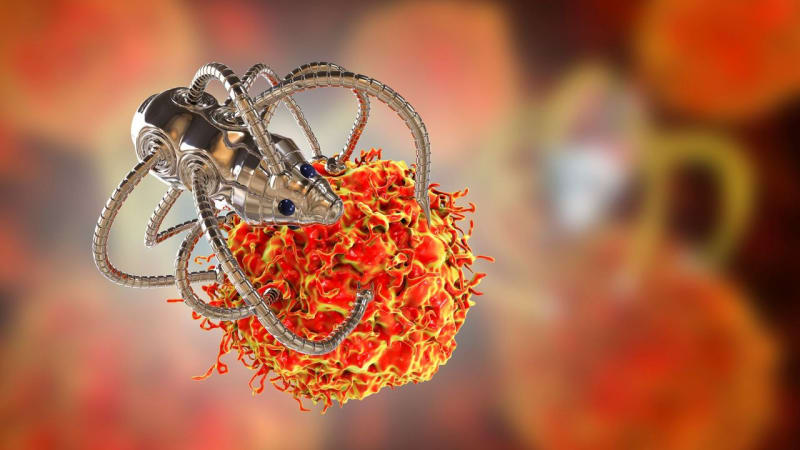
Feynman's visionary lecture explored seemingly fantastical technological possibilities that sound like science fiction: electron microscopes capable of atom-level manipulation, ultracompact data storage, miniature computers, and even microscopic medical machines that could travel inside human organs, detecting and repairing defects with tiny surgical instruments. To demonstrate his seriousness, he offered two $1,000 prizes: one for miniaturizing text 25,000-fold and another for creating a motor smaller than 1/64th of an inch cubed.
The first prize was claimed in 1985 by Stanford graduate Thomas Newman, who miniaturized the opening page of Charles Dickens' "A Tale of Two Cities". The motor challenge was met even earlier, in 1960, by engineer William McLellan, who crafted a 250-microgram motor composed of just 13 intricate parts. Feynman good-naturedly joked in his congratulatory letter that McLellan shouldn't get too ambitious about "writing small" and potentially winning the text miniaturization prize too.
Interestingly, while Feynman's lecture is now celebrated as the conceptual birthplace of nanotechnology, the term itself wasn't coined until 1974 by scientist Norio Taniguchi, who defined it as the processing of materials at the atomic or molecular scale. Many science historians argue that the field was already developing independently, and Feynman's talk, while prescient, wasn't the sole driver of future innovations.
Yet, the subsequent decades have spectacularly validated Feynman's predictions. By 1990, scientists were manipulating individual xenon atoms using scanning tunneling microscopes. Today, computers exponentially more powerful than Feynman could have imagined fit in our pockets, and nanobots capable of repairing blood vessels have transitioned from theoretical concept to medical reality.
Feynman's lecture stands as a remarkable testament to human imagination - a moment when one brilliant mind dared to see beyond current technological limitations and glimpse a future where the smallest scales of matter could be understood, controlled, and transformed. His vision continues to inspire scientists and innovators worldwide, reminding us that today's seemingly impossible ideas might well become tomorrow's groundbreaking technologies.
Based on reporting by Live Science
This story was written by BrightWire based on verified news reports.
More Good News
 🚀 Innovation
Electrifying Deal: Dodge Charger EV Slashes Prices by Nearly 50%
 🚀 Innovation
CATL's Sodium-Ion Battery Revolution: A Breakthrough in Electric Vehicle Technology
 🚀 Innovation
Home Tech Revolution: 5 Breakthrough Innovations That Are Changing Everyday Living
Start Your Day With Good News
Join 50,000+ readers who wake up to stories that inspire. Delivered fresh every morning.
No spam, ever. Unsubscribe anytime.