Hidden Hope: Thailand's Flat-Headed Cats Emerge from Shadows After 30-Year Absence
In a stunning wildlife revelation, Thailand's flat-headed cats have reappeared after 30 years, offering hope for a species once thought extinct. The discovery, made through extensive camera trap surveys, highlights the importance of persistent conservation efforts.
In a remarkable testament to nature's resilience, Thailand's elusive flat-headed cats have defied extinction expectations, appearing in a groundbreaking wildlife survey that offers renewed hope for this mysterious species.
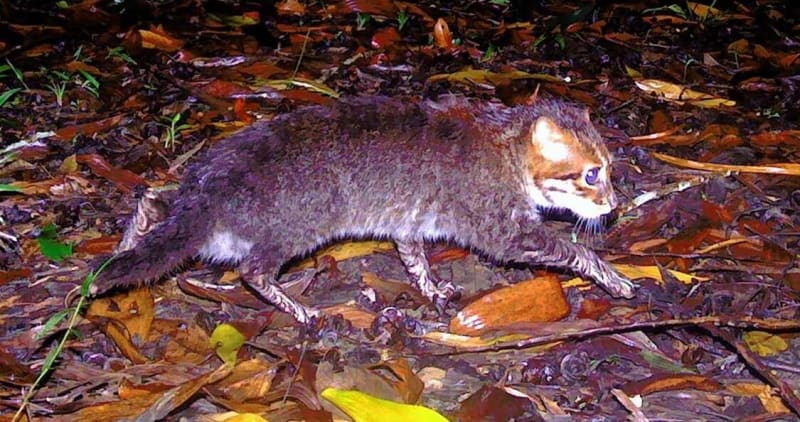
Wildlife authorities have confirmed the first confirmed sightings of these rare felines in southern Thailand's Princess Sirindhorn Wildlife Sanctuary, where night-vision cameras documented an astounding 29 separate encounters—including a touching moment of a mother cat with her kitten. The last confirmed sighting was in 1995, making this discovery a significant milestone for conservation efforts.
These nocturnal hunters, specialized for aquatic environments, possess an extraordinary ability to catch prey by submerging their entire head underwater to strike fish, frogs, and crustaceans. Their remarkable adaptations include hunting in challenging wetland ecosystems like peatlands, mangrove forests, and marshes that have historically made them incredibly difficult to track.
Dr. Kaset Sutasha from Kasetsart University expressed cautious optimism about the discovery, noting that while exciting, the critical challenge remains ensuring sustainable coexistence. "What comes after this is more important—how to enable them to live alongside us sustainably, without being threatened," Sutasha explained to the South China Morning Post.
The conservation organization Panthera, renowned for its wild cat preservation work, played a pivotal role in this breakthrough. The organization's founder, Dr. Thomas Kaplan, has long emphasized that understanding these elusive creatures requires extensive field research and camera trap surveys to establish baseline population data.
Despite the encouraging news, researchers remain concerned about habitat fragmentation potentially limiting the cats' hunting ranges and genetic diversity. The flat-headed cat's survival hinges on protecting its delicate wetland ecosystems and understanding its complex ecological requirements.
With Panthera's expertise and commitment to wildlife conservation, there is genuine hope that these remarkable cats can be protected and potentially restored to healthier population levels. The discovery serves as a powerful reminder that even species believed lost can surprise us with their tenacity and resilience.
Based on reporting by Good News Network
This story was written by BrightWire based on verified news reports.
More Good News
 🌍 Planet
Innovative Solar Solution: ZOUPW 450W Portable Panel Revolutionizes Off-Grid Power Generation
 🌍 Planet
Conservation or Displacement? The Complex Story of Tanzania's Game Reserves
 🌍 Planet
Electric Vehicle Giants BYD and Tesla Dominate Global Battery Electric Vehicle Market
Start Your Day With Good News
Join 50,000+ readers who wake up to stories that inspire. Delivered fresh every morning.
No spam, ever. Unsubscribe anytime.