Cosmic Discovery Reveals Baby Stars' Hidden Growth Process in Stunning Detail
Astronomers unveil stunning details of stellar birth in the Perseus constellation, mapping 400 cosmic 'rings' that reveal how young stars grow and expel surrounding material. This groundbreaking discovery provides unprecedented insights into the dynamic process of star formation.
In the quiet, dark expanses of the Perseus constellation, astronomers have uncovered a breathtaking window into stellar birth, revealing an intricate dance of cosmic creation that challenges decades of scientific understanding. Using the cutting-edge Atacama Large Millimeter/submillimeter Array (ALMA) radio telescope in Chile, researchers have captured an unprecedented 3D view of a young star's explosive growth, mapping over 400 delicate, ring-like structures that chronicle its tumultuous early life.
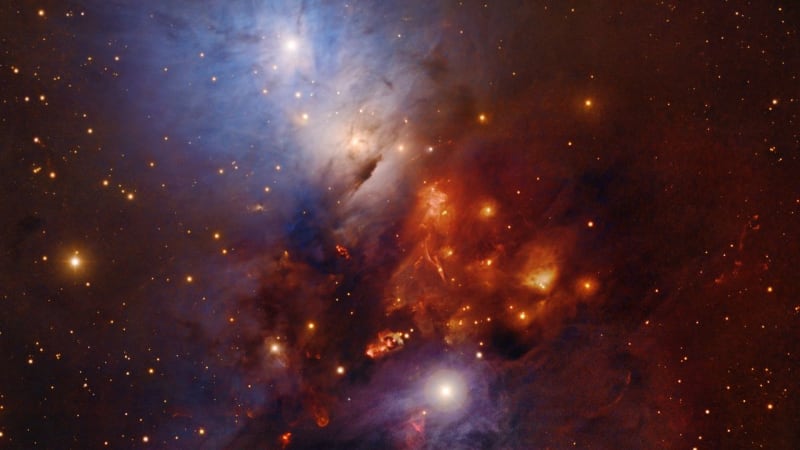
The star system SVS 13, nestled within the NGC 1333 nebula—affectionately dubbed the 'Embryo Nebula'—has become a celestial canvas displaying the most detailed image of a newborn star's jet ever recorded. Located just 1,000 light-years from Earth, this reflection nebula glows with the intense light of newly formed stars, offering scientists a rare, close-up view of stellar formation processes that have long remained mysterious.
Published in the journal Nature Astronomy on December 16, the groundbreaking research provides the first direct observational confirmation of how young stars consume and dramatically expel surrounding material. The 400 ultra-thin, bow-shaped molecular rings act like cosmic tree rings, each marking a distinct moment of energetic outburst in the star's early history. Remarkably, the youngest ring precisely matches a bright outburst observed in the SVS 13 system during the early 1990s, allowing researchers to connect specific burst activities directly to changes in the star's jet speed.
Study co-author Gary Fuller, a professor at the University of Manchester, described the significance of their findings with infectious enthusiasm: 'These images give us a completely new way of reading a young star's history. Each group of rings is effectively a time-stamp of a past eruption. It gives us an important new insight into how young stars grow and how their developing planetary systems are shaped.'
The research suggests that sudden bursts in jet activity are triggered by massive amounts of gas falling onto a young star, a process that has until now existed primarily in theoretical models. By capturing these intricate details, astronomers are peeling back the layers of cosmic mystery, revealing the complex mechanisms that transform diffuse molecular clouds into fully-formed stellar systems.
For stargazers and science enthusiasts, the NGC 1333 region offers a tantalizing glimpse into the dynamic processes that create the stars we see twinkling in our night sky. Though invisible to the naked eye, this stellar nursery represents a vibrant, ongoing story of creation happening right in our cosmic backyard, reminding us that the universe is constantly in motion, perpetually birthing new worlds and possibilities.
Based on reporting by Live Science
This story was written by BrightWire based on verified news reports.