Cosmic Breakthrough: James Webb Telescope Captures Supernova from Universe's Infancy
Scientists using the James Webb Space Telescope have captured the most distant supernova ever observed, providing an unprecedented glimpse into the early universe. The discovery challenges previous understanding of stellar explosions and offers a rare window into cosmic evolution.
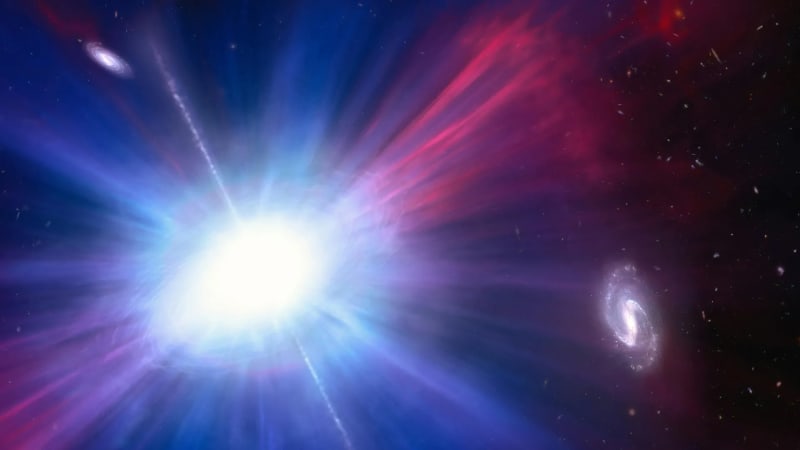
In a groundbreaking astronomical discovery, scientists have peered into the depths of cosmic time, witnessing the explosive death of a massive star when the universe was barely 730 million years old. Using the James Webb Space Telescope (JWST), researchers have captured an unprecedented view of a supernova that offers a rare window into the early stages of our universe's evolution.
The spectacular event, designated SN in GRB 250314A, was first detected on March 14, 2025, when a powerful gamma-ray burst caught the attention of astronomers worldwide. The space-based multi-band astronomical Variable Objects Monitor (SVOM) initially identified the high-energy radiation, prompting follow-up observations by the European Southern Observatory's Very Large Telescope (ESO/VLT) to confirm the extreme distance of this cosmic explosion.
Dr. Antonio Martin Carrillo from the UCD School of Physics highlighted the significance of the discovery, explaining that confirming a supernova at this distance is extraordinarily rare. "The key observation that connects the death of massive stars with gamma-ray bursts is finding a supernova emerging at the same sky location," he noted. "Almost every supernova ever studied has been relatively nearby, making this a unique opportunity to probe the early Universe."
Remarkably, the JWST's Near Infrared Camera (NIRCAM) captured images about 110 days after the initial burst, allowing researchers to isolate the fading light of the supernova from its host galaxy. What surprised scientists most was how closely this distant supernova matched SN 1998bw, a well-known explosion much closer to Earth. Despite forming in a dramatically different environment with lower metallicity, the star appeared to die in a remarkably familiar way.
The discovery challenges long-held beliefs about the first generations of stars. Scientists had previously assumed that the earliest stellar explosions would be distinctly brighter or bluer than those seen today. Instead, the findings point to a surprising consistency in how massive stars end their lives across cosmic time. The data also definitively ruled out the possibility of a far brighter explosion type, such as a Superluminous Supernova (SLSN).
While the observation provides a crucial reference point for understanding stellar evolution in the early universe, it simultaneously opens up new questions about the uniformity of these cosmic explosions. The research team plans additional JWST observations within the next one to two years, hoping to study the supernova as it fades and gain even more insights into the host galaxy and the precise nature of the explosion.
This breakthrough represents more than just an astronomical achievement. It's a testament to human curiosity and our ability to peer back in time, using cutting-edge technology to understand the fundamental processes that shaped our universe billions of years ago.
Based on reporting by Science Daily
This story was written by BrightWire based on verified news reports.
More Good News



Start Your Day With Good News
Join 50,000+ readers who wake up to stories that inspire. Delivered fresh every morning.
No spam, ever. Unsubscribe anytime.