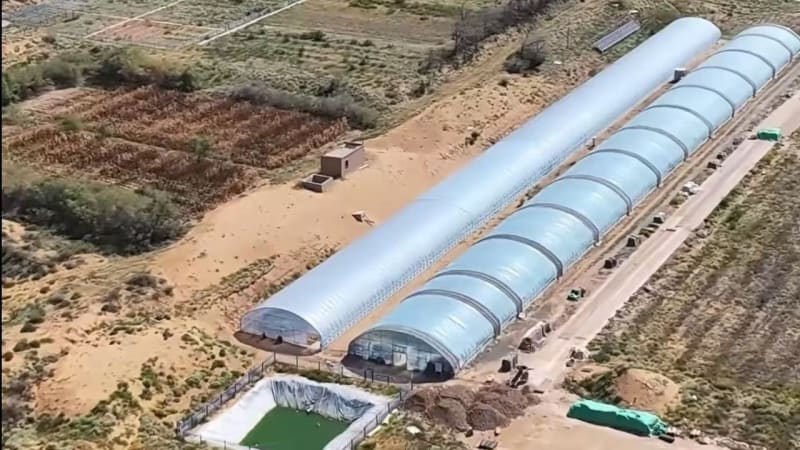
China's Innovative Blue-Green Algae Strategy Transforms Desert Landscapes
Chinese scientists are pioneering a groundbreaking desert restoration technique using resilient cyanobacteria. This revolutionary approach could help reclaim thousands of hectares of arid land and combat desertification.
In the harsh, unforgiving landscapes of northwest China's Tengger Desert, scientists are waging a remarkable battle against environmental degradation using an unlikely ally: microscopic blue-green algae.
Researchers at the Shapotou Desert Experimental Research Station, affiliated with the Chinese Academy of Sciences, have developed a sophisticated biological technique that could revolutionize desert reclamation efforts. By carefully selecting specific strains of cyanobacteria capable of surviving extreme heat and prolonged drought, they are creating a living foundation capable of transforming barren landscapes.
These specially engineered microorganisms lie dormant during dry periods, springing to life when rain finally arrives. Once activated, they rapidly spread across sandy terrain, forming a dense, biomass-rich crust that stabilizes sand dunes and creates an ideal environment for future plant growth.
The technique, developed over more than a decade of meticulous research, is now being implemented as part of Ningxia Hui autonomous region's ambitious sand control strategy. Under the broader 'Great Green Wall' initiative, scientists expect to treat approximately 5,333-6,667 hectares of desert within the next five years.
Located in the city of Zhongwei, the research station has been at the forefront of this innovative approach. By harnessing the natural resilience of cyanobacteria, they are offering a sustainable solution to one of humanity's most persistent environmental challenges: transforming lifeless desert regions into potentially fertile landscapes.
As climate change continues to threaten global ecosystems, this groundbreaking method represents a beacon of hope—demonstrating how cutting-edge scientific research can work in harmony with natural biological systems to restore and regenerate our planet's most challenging environments.
Based on reporting by South China Morning Post
This story was written by BrightWire based on verified news reports.
More Good News
 🌍 Planet
Innovative Mushroom Caskets Offer Eco-Friendly Final Journey in Groundbreaking North American Burial
 🌍 Planet
Climate Hope: How Grassroots Movements Are Reshaping Environmental Justice
 🌍 Planet