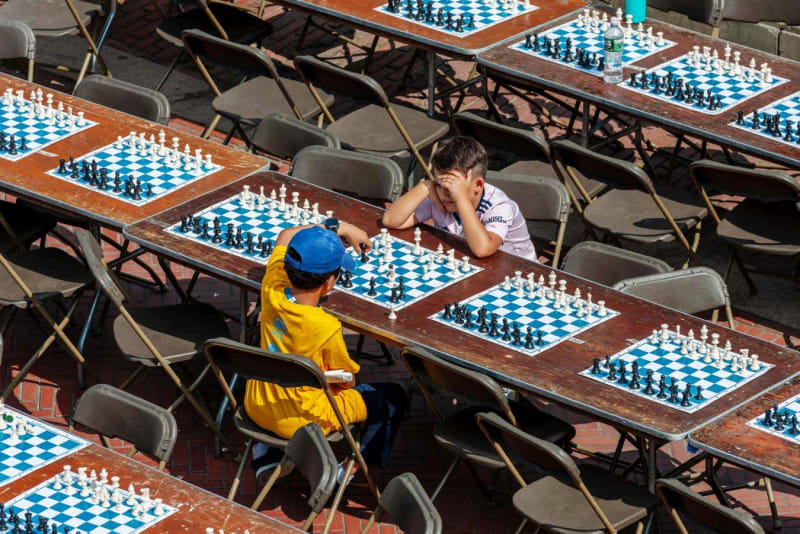
Chess Revolutionized: How Randomizing Pieces Could Level the Playing Field
A groundbreaking study reveals how shuffling chess piece starting positions could create more balanced and exciting matches. Physicist Marc Barthelemy uncovers surprising insights into game complexity and fairness.
Chess, a game of strategic brilliance, might be on the verge of a dramatic transformation that could make every match more unpredictable and engaging.
Physicist Marc Barthelemy from Paris-Saclay University has discovered that randomizing chess piece starting positions could fundamentally change how players approach the game, challenging centuries of traditional gameplay.

The classic chess setup, with its symmetrical arrangement of pieces, has long allowed top players to memorize optimal opening strategies, often leading to predictable matches. In the 1990s, chess grandmaster Bobby Fischer proposed a revolutionary alternative: Chess960, which randomizes piece placement while maintaining basic positional rules.
By analyzing all 960 possible starting configurations using the Stockfish chess computer, Barthelemy made a fascinating discovery: not all random arrangements are equally balanced. Some configurations dramatically favor white or black players, while others create remarkably complex strategic landscapes.
Surprisingly, Barthelemy found that the standard chess position is remarkably average – neither exceptionally balanced nor asymmetrical. The most complex starting arrangement emerged as BNRQKBNR, while QNBRKBNR offered the most balanced gameplay between players.

Vito Servedio from the Complexity Science Hub argues that randomness itself ensures inherent fairness, preventing grandmasters from relying on memorized opening strategies. "A grandmaster knows thousands of opening lines in standard chess, but cannot know the opening lines in all the [Chess960] positions," Servedio explains.
This research opens exciting possibilities for tournament organizers and chess enthusiasts, suggesting that introducing controlled randomness could make the game more dynamic and skill-dependent. By disrupting traditional memorization, Chess960 potentially levels the playing field, rewarding genuine strategic thinking over rote learning.

As chess continues to evolve, Barthelemy's research represents a fascinating intersection of mathematics, strategy, and game design – proving that even ancient games can be reimagined to create more engaging, fair, and intellectually challenging experiences.
Based on reporting by New Scientist
This story was written by BrightWire based on verified news reports.
Spread the positivity! 🌟
Share this good news with someone who needs it
More Good News
 💡 Solutions
Ondo Governor Grants Fresh Start to 77 Inmates through Compassionate Clemency
 💡 Solutions
Rivers Governor Fubara Expands Leadership Team with Five Strategic Special Advisers
 💡 Solutions