Ancient Human Ancestor's Walking Style Reveals Surprising New Evidence
Groundbreaking research suggests our earliest human-like ancestor walked upright, challenging previous scientific understanding about human evolution. Researchers have discovered compelling anatomical evidence that rewrites our understanding of ancient human locomotion.
In a groundbreaking scientific investigation, researchers have potentially solved one of paleoanthropology's most intriguing mysteries about our earliest human-like ancestors.
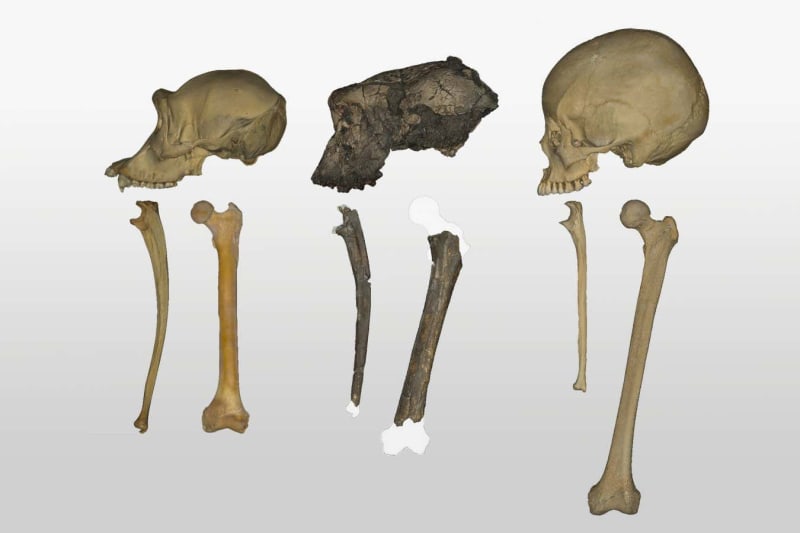
Scott Williams from New York University and his colleagues have conducted a meticulous reanalysis of Sahelanthropus tchadensis fossils, suggesting this 7-million-year-old species might have been walking upright - challenging previous assumptions about early human locomotion.

The fossils, originally discovered in Chad's desert region in 2002, have been at the center of a heated scientific debate. The ancient creature's skull, with its pronounced brow ridge and small canines, immediately distinguished it from great apes and hinted at a potentially unique evolutionary path.
Williams and his team focused on three critical anatomical features of the fossil's femur and ulna bones. By examining the muscle attachment points, bone proportions, and a previously overlooked feature called the "femoral tubercle", they found compelling evidence suggesting bipedal movement.
"I actually initially identified the femoral tubercle by touch, then confirmed it visually using 3D scans of the fossil," Williams explained. This small bump serves a crucial function in human walking mechanics, helping stabilize the hip joint during upright movement.
The research builds upon decades of conflicting scientific interpretations. While some researchers argued the bones suggested ape-like knuckle-walking, Williams' team presents strong evidence pointing toward human-like bipedal locomotion.
Despite the promising findings, Williams remains appropriately cautious. "We're fairly convinced that Sahelanthropus was an early bipedal hominin at this point," he noted, "but I'd be foolish to think we ended the debate."

The study represents another fascinating chapter in understanding human evolutionary history, demonstrating how careful scientific analysis can gradually unveil the complex story of our ancient origins.
Based on reporting by New Scientist
This story was written by BrightWire based on verified news reports.
Spread the positivity! 🌟
Share this good news with someone who needs it
More Good News
 🌍 Planet
British Waters Explode with Octopus Population: A Record-Breaking Marine Marvel
 🌍 Planet
Five Tiger Cubs Captured in Rare Camera Trap Footage: Conservation Victory in China
 🌍 Planet